Putting the Team in TeamWorks
Lee County High’s All-Girls Competition Team Celebrates Each Other’s Strengths
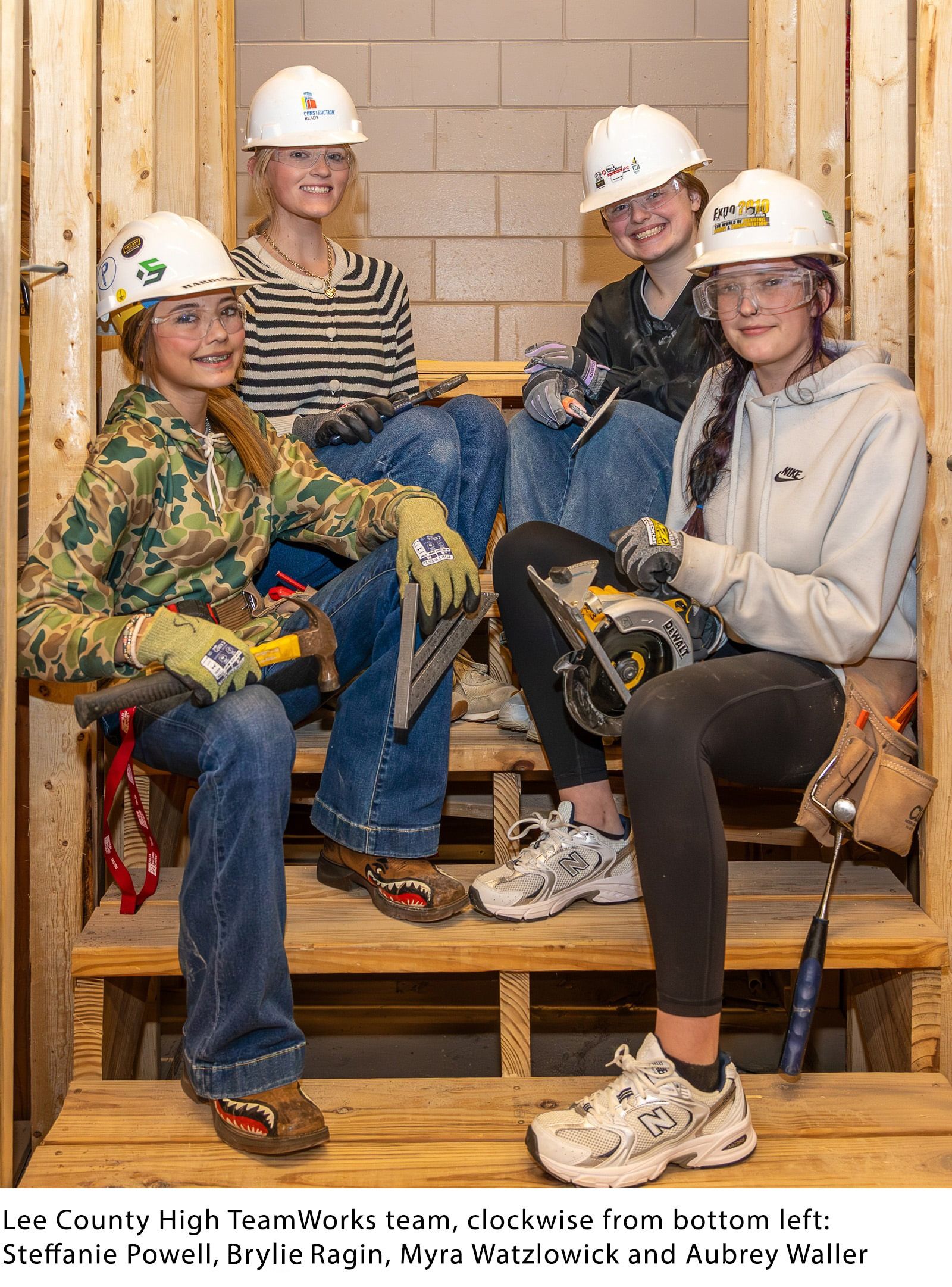
In the world of construction skills contests, the sight of an all-girls team is sure to attract attention. Heads did indeed turn when such a group from Lee County High School showed up at the Associated General Contractors of Georgia’s South + Southwest Georgia Skills Challenge in Moultrie last November. The response was mostly positive – but there were some doubters as well.
“There was one group of boys we were competing against who were looking at us and laughing,” recalls Steffanie Powell, the dynamic 11th-grader who serves as her team’s leader and plumbing specialist.
As sophomore Brylie Ragin remembers it, “They were pointing and laughing.”
Then a funny thing happened. “We just so happened to beat them,” Powell says.
That victory secured a spot at the SkillsUSA Georgia Championships in Atlanta on February 19-20. Aubrey Waller and Myra Watzlowick, also sophomores, will join Powell and Ragin in the TeamWorks contest, in which each four-person unit completes a project that demonstrates their ability to work together using carpentry, roofing, electrical, plumbing and masonry skills.
The Moultrie win was only the girls’ second competitive event; the previous day they had finished third in AGC Georgia’s Southeast Georgia Skills Challenge in Statesboro. They are thought to be the first all-girls team to win a TeamWorks contest in Georgia. The key to their success, according to their construction teacher, is built right into the competition’s name – they truly work as a team.
“I knew there was a novelty to it, being an all-girls team,” says Lee County CTAE Instructor John Wanner. “But when we got to the competition and I watched what they did, I said, ‘Oh, they get it. They get the teamwork aspect.’ The judges told me, ‘What made the difference in these girls beating out these all-guy teams is their teamwork. They’re not fussing. They’re not saying, ‘I know everything, get out of my way.’ They’re helping each other.”
Building a Team
Powell, Waller, Watzlowick and Ragin all came to Wanner’s construction program with varying degrees of exposure to the skilled trades, mainly through their fathers and other male family members. Powell’s father, for example, installs acoustic ceilings, and an uncle makes cabinets. Waller’s dad works in flooring. All had an interest in working with their hands.

Now Wanner is nurturing, encouraging and shaping them into skilled and confident practitioners of their craft. Powell and Watzlowick are in their second year with the program; for Waller and Ragin, it’s their first. Like all of Wanner’s students, each started with the fundamentals, including the pounding of nails – lots and lots of nails.
“That’s the biggest shortcoming for students at this age,” Wanner says. “Even my boys, when they’re young, they can pound a nail or two, but to do it for two hours straight, they’re physically exhausted. So they pound hundreds of nails to get that hand strength and coordination.”
Powell acknowledges that “pounding nails is a lot of work,” but she’s not one to back down from a challenge. In fact, she uses her diminutive size as motivation: Her personal motto is “I’m tiny but mighty.”
Wanner calls Powell “a natural leader,” someone whom “people will follow. They will do what she wants them to do; she has that personality.”
The other team members have their unique traits and skills as well. Blending it all together is the goal as they approach the state championship in Atlanta. Powell and Waller handle much of the carpentry work. Watzlowick is the masonry specialist. Ragin is the electrician, a role she’s quickly embraced.
“I started learning electrical basically just for this TeamWorks team, and I really like it,” Ragin says. “It just seems easy for me to do.
“She picked it up and ran with it,” Wanner says. “She’s got a real talent.”
Watzlowick, meanwhile, fills the mason role, which Wanner says is an underrated but critical skill in TeamWorks.
“It’s almost always the mason who is the shortcoming,” he says. “It will make or break you, and you need someone who really wants to do it. I knew Myra from last year, and I knew she wanted to do masonry, and I knew she had the skill set and the want and the drive.”

For Powell, trusting her teammates has been part of the learning process.
“I’m hands-on and I like to work by myself,” she explains, “Being team leader, at first it was me doing a bunch of the stuff, pounding nails, putting stuff together, and they were just standing around. [Wanner said], ‘You have to let them do something.’ So I’ve learned to let them do what they do best. I’ve learned that I can’t do everything by myself.”
To that end, Ragin fulfills another role. “Briley is like the mom of the group,” Powell says. “I’ll have a stupid idea and she’ll be like, ‘There might be an easier way to do that.’”
If they’ve done their jobs well, the end result is immensely satisfying. “I love assembling all the pieces,” says Waller. “That’s the best part, to see when we get it all right.”
Growing the Workforce
Wanner goes about his work with an eye on the big picture. “The focus is getting young people into the workforce,” he says. He’s built a lucrative network of local and regional industry contacts to whom he can funnel students for summer and Work-Based Learning (WBL) jobs, and graduates for full-time careers.
“If I can get them out there working at [age] 15 or 16, they don’t leave,” Wanner says. “Rarely does one of my students leave the field once they get a taste of it. I’ve got jobs all over, from mom-and-pops to big, 200-employee general contractors. And they’re really good at taking my girls – I have no trouble getting girls jobs if they want to go straight to work [after high school].”
Wanner, who received Construction Ready’s 2023 Construction Teacher of the Year Award, regularly leans on his teacher connections for ideas to improve his program. They learn from each other at Construction Ready’s Camp T&I (Trade & Industry) gatherings every summer and stay in contact throughout the year.
“It’s the collaborative nature of what Construction Ready has built across the state,” he says. “I mean, we’re tight. We all have each other’s numbers. We know each other well.”

At this point in their high school educations, Powell and her teammates each can envision a career in the skilled trades. Wherever they end up, it’s clear they will have benefitted from their time in Wanner’s classroom and shop.
“He’s about shop work, but he’s not just about shop work – he’s about teaching you life skills and life lessons, too,” Powell says. “He’s good at showing you how to be you.”
Adds Waller: “He’s taught me how to do things on my own and really take accountability for my work.”
And Watzlowick: “He really teaches life skills and things that will help just not in the shop but also outside in your actual life as you continue on.”
Of course, the hands-on abilities are a big benefit as well. Even if they don’t ultimately lead to a career, knowing how to wield a hammer or wire an electrical outlet are valuable skills to have in any environment.
“We can do this; we don’t need a man in our lives,” Ragin says as her teammates laugh and nod in agreement.
To be sure, construction is a male-dominated industry. But as these Lee County High students demonstrate, there’s ample room for women to not only participate, but to thrive.
“When someone says I’m bad at something,” Waller explains, “it makes me want to do everything I can to be good at it.”
“And,” adds Powell, “prove them wrong.”


Copyright © 2026 Construction Ready. All Rights Reserved.